

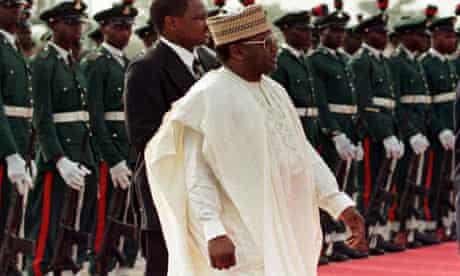

Veteran journalist Tony Eluemunor has disputed claims by former Department of State Services (DSS) Assistant Director of Operations, Dennis Amachree, that late Head of State, General Sani Abacha, died while in bed with a woman, insisting that the former security operative misrepresented the circumstances surrounding the military ruler’s death.
In a detailed rebuttal titled “No, Abacha Didn’t Die in Bed with a Woman: Dennis Amachree Misrepresented How He Died,” Eluemunor argued that Amachree’s account in his recently published memoir, DSS @40: My Journey Behind the Shield, was based on an incomplete and unverified personal narrative rather than the conclusions reached by Nigeria’s security agencies after extensive investigations.
Amachree had claimed in his yet to be published book that Abacha suffered a fatal heart attack in June 1998 while with a female pharmacist at the Aso Rock Guest House. According to him, the woman later told DSS investigators that the former Head of State “died on top of me,” a statement he presented as the definitive account of Abacha’s death.
However, Eluemunor described the claim as misleading, arguing that it ignored the findings of coordinated investigations conducted by the DSS, National Intelligence Agency (NIA), Military Intelligence and the Office of the National Security Adviser. He maintained that Amachree, who was then serving as Assistant Director in charge of Travel Control, was not directly involved in the broader investigation and therefore lacked access to its final conclusions.
The veteran journalist, who was at the time the Daily Independent newspaper’s Abuja Bureau Chief, said information he gathered during years of research for an unpublished book on Nigeria’s presidency showed that Abacha was already battling serious health conditions, including asthma, diabetes and liver sclerosis, before his death. He stated that after receiving medical treatment on June 7, 1998, Abacha retired to bed, later rose to receive a few visitors, including then FCT Minister, the late General Jeremiah Useni, before suffering a fatal medical emergency.
Eluemunor further claimed that contrary to long-standing rumours involving Indian women, the visitors at the presidential villa that night were two Filipino women who had lived in Kano for years and were known to security personnel. He insisted there was no evidence that Abacha died during any sexual encounter, adding that available information indicated the former military ruler collapsed while fully clothed after an asthma attack, having reportedly left his inhaler behind.
Beyond challenging Amachree’s narrative, Eluemunor also referenced what he described as intelligence conclusions suggesting that Abacha’s deteriorating health may have been worsened by exposure to a toxic substance during a handshake with a member of late Palestinian leader Yasser Arafat’s delegation hours before his death. According to him, security agencies later reviewed official recordings and investigated the possibility that a suspected foreign double agent may have administered the substance.
He acknowledged, however, that no autopsy was conducted on Abacha’s body, meaning the precise medical cause of death could not be conclusively established. Nevertheless, Eluemunor argued that the findings reached by multiple Nigerian intelligence agencies carried greater credibility than what he described as Amachree’s reliance on the account of a single witness.
The journalist concluded that portraying Abacha as having died during an intimate encounter with a woman distorted Nigeria’s historical record and overlooked the extensive investigations carried out by the country’s security establishment. He urged readers to distinguish between a personal memoir and what he described as the institutional findings on one of Nigeria’s most controversial political deaths.
