

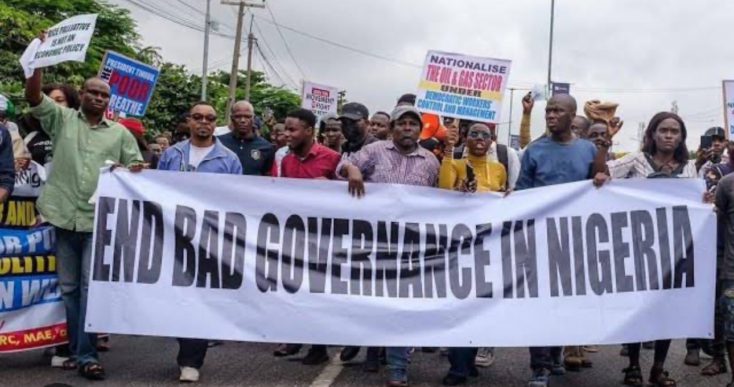

In any functioning democracy, the press and civil society are meant to serve as the conscience of the nation—unyielding, fearless, and persistently vocal in the face of injustice. Yet in today’s Nigeria, one cannot ignore the troubling quietness of institutions that should be amplifying the cries of the suffering masses. At a time when hardship deepens daily, the watchdogs appear sedated, if not complicit.
Under the administration of Bola Ahmed Tinubu, Nigerians have been subjected to economic policies whose impacts have been swift and severe—fuel subsidy removal, currency instability, rising inflation, and a crushing cost of living crisis. While these policies may have been justified as necessary reforms, their execution has left millions grappling with hunger, job loss, and uncertainty. In such moments, a vibrant press and active democracy advocates should rise—not retreat.
A Press That Whispers Instead of Roars
Historically, the Nigerian press has played heroic roles. From the anti-colonial struggles to the fight against military dictatorship, journalists risked imprisonment and death to speak truth to power. Today, however, much of that courage appears diluted. Major media houses now often operate within the constraints of political affiliations, corporate interests, and survival economics.
Instead of investigative journalism that exposes policy failures and corruption, what dominates are recycled press statements, soft interviews, and selective outrage. Critical questions are rarely sustained. Stories of suffering—markets collapsing, hospitals underfunded, youth unemployment—flash briefly before disappearing from the headlines.
The result is a dangerous normalization of hardship. When the press fails to consistently spotlight injustice, the public begins to internalize suffering as inevitable.
Democracy Activists: From Resistance to Relevance Crisis
Nigeria’s democracy activists and civil society organizations once stood as formidable forces. During eras of military rule, they mobilized protests, challenged authority, and inspired hope. Today, many of these groups appear fragmented, underfunded, or strategically silent.
Some activists have been absorbed into government structures, blurring the line between watchdog and participant. Others issue statements that lack urgency or fail to translate into meaningful action. Street protests, once a powerful tool have dwindled, partly due to state repression but also due to weakened coordination and fear.
The question arises: where are the organized voices demanding accountability for policy failures? Where is the sustained pressure that forces leadership to respond to the people?
The Cost of Silence
Silence in times of widespread suffering is not neutral; it is consequential. When institutions meant to check power grow quiet:
Government excesses go unchecked; Public frustration festers without direction; and Democratic accountability erodes
Citizens lose faith in both leadership and advocacy structures. In such an environment, democracy becomes hollow reduced to periodic elections without continuous accountability.
Fear, Fatigue, or Complicity?
The reasons for this silence are complex. Economic pressures on media organizations make them vulnerable to political influence. Activists face intimidation, surveillance, and shrinking civic space. There is also a growing sense of fatigue among the populace—years of struggle with little visible change.
However, these challenges do not justify inertia. If anything, they demand greater innovation, courage, and solidarity.
Rekindling the Democratic Spirit
Nigeria’s path forward depends significantly on reviving the strength of its press and civil society. This means: Independent journalism that prioritizes truth over access;
Coalition-building among activists to amplify impact; Grassroots mobilization that reconnects advocacy with everyday citizens; and
Relentless accountability campaigns that keep pressure on leadership. Democracy is not self-sustaining—it requires constant vigilance. When the press sleeps and activists whisper, power grows unchecked, and the masses pay the price.
Conclusion
Nigeria stands at a critical juncture. The suffering of its people is neither abstract nor exaggerated—it is visible in empty plates, shuttered businesses, and restless youth. At such a time, silence from those entrusted to defend democracy is not just disappointing; it is dangerous.
The Nigerian press and democracy activists must awaken, not gradually, but urgently. Because when the voices meant to challenge power fall silent, the very soul of democracy is at risk.
