

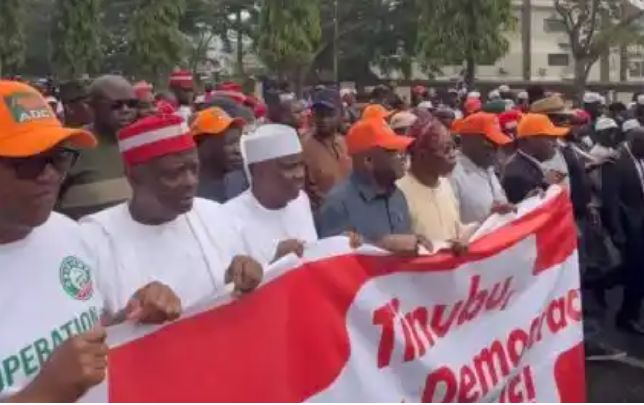
Nigeria stands at a defining moment in its democratic journey. The ongoing protest in Abuja, boldly tagged “Occupy INEC#”, is not merely a political demonstration but a loud cry against what many perceive as the growing arbitrariness of the Independent National Electoral Commission (INEC) and its alleged alignment with the administration of Bola Ahmed Tinubu.
At the forefront of this resistance are leading opposition figures including Atiku Abubakar, Peter Obi, Rabiu Musa Kwankwaso, and Rotimi Amaechi—a coalition that reflects a rare convergence of political interests united by a common concern: the survival of Nigeria’s democracy.
At its core, the protest raises fundamental questions about electoral integrity, institutional independence, and the rule of law. INEC, as the custodian of Nigeria’s electoral process, is expected to operate above partisan interests. However, growing public distrust suggests a dangerous perception that the commission may no longer be an impartial umpire. If left unaddressed, this erosion of confidence could have far-reaching consequences for democratic governance.
The implications of a mass mobilization of citizens in support of the “Occupy INEC#” protest are profound. First, it would signal a reawakening of civic consciousness among Nigerians; a clear message that the electorate will no longer remain passive in the face of perceived injustice. A large-scale turnout would amplify both local and international scrutiny on Nigeria’s democratic institutions, potentially compelling reforms or, at the very least, forcing accountability.
However, such mass action also carries inherent risks. History has shown that when public anger meets institutional resistance, the outcome can be volatile. A nationwide surge in protests could escalate tensions, strain security apparatus, and disrupt socio-economic activities. More critically, it may deepen political polarization, pushing the country further into ideological divides that weaken national cohesion.
Yet, beyond the risks lies an undeniable truth: democracy thrives on participation, vigilance, and the courage to challenge authority when necessary. If Nigerians troop out en masse, it could redefine the relationship between the governed and those in power. It would serve as a referendum on governance under the current administration, testing the resilience of democratic structures against allegations of manipulation and control.
For the Tinubu government, this moment presents both a challenge and an opportunity. Suppressing dissent could reinforce claims of authoritarianism, while engaging with protesters and addressing their grievances could restore confidence in democratic processes. The choice made at this critical juncture will shape not only public perception but also Nigeria’s democratic legacy.
Ultimately, the “Occupy INEC#” protest is more than a confrontation between opposition leaders and the government—it is a battle for the soul of Nigeria’s democracy.
Whether it leads to meaningful reform or further discord will depend on the actions of all stakeholders: the government, the electoral body, the opposition, and, most importantly, the Nigerian people.
In times like this, silence is complicity. The future of Nigeria’s democracy may well be determined by the voices that rise or fail to rise today.
