

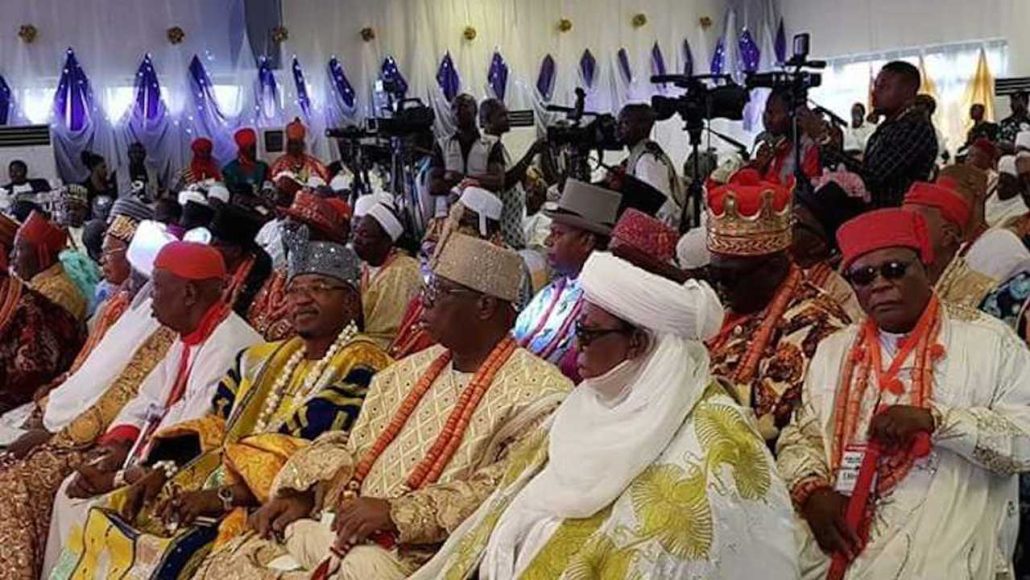

For centuries before the emergence of the modern Nigerian state, traditional rulers occupied the centre of community administration, justice, social order, conflict resolution and development. The Oba, Emir, Obi, Sultan and other traditional authorities were not merely custodians of culture; they were institutions of governance through which communities organised their affairs and maintained social cohesion.
Today, however, the constitutional position of traditional rulers in Nigeria is markedly different.
They remain highly respected and influential among their people, but their formal governmental powers have been progressively reduced, leaving many of them principally with cultural, ceremonial and advisory responsibilities.
This transformation has generated an enduring question: Should traditional rulers continue to remain largely outside Nigeria’s formal governance structure, or should the Constitution give them clearly defined responsibilities in the affairs of the country?
The question is particularly relevant as His Imperial Majesty, Oba Rashidi Adewolu Ladoja, Arusa I, the 44th Olubadan of Ibadanland, marks his first anniversary on the throne.
The debate is not about turning traditional rulers into politicians or making them competitors to elected governments. Rather, it is about recognising the traditional institution as an important part of Nigeria’s social and governance architecture and giving it an appropriate constitutional place.
How traditional rulers lost their governmental powers
Nigeria’s traditional institutions once exercised considerably greater authority in local administration. Historical studies show that traditional authorities occupied a central position in administration under the system of indirect rule, although the extent of their authority varied across the regions. In the South, many of their local-government functions had already been transferred to elected councillors through reforms in the 1950s, while traditional rulers in Northern Nigeria retained greater influence until the 1976 reforms.
The 1976 Local Government Reforms represented a major turning point.
The reforms established a more uniform local-government system and transferred substantial local administrative authority to elected local councils. Academic literature describes the traditional rulers as subsequently being insulated from partisan politics and assigned mainly advisory functions through traditional or emirate councils.
In effect, a new relationship emerged between the traditional institution and the modern local government.
The elected local government chairman became the political and administrative head of the local council, while the traditional ruler became largely an adviser and custodian of culture.
That arrangement may have served the administrative objectives of its time. But almost five decades later, questions are increasingly being raised about whether the country has fully utilised the enormous social capital residing in its traditional institutions.
The constitutional gap
One of the strongest arguments for reform is that the 1999 Constitution does not provide a comprehensive constitutional role for traditional rulers.
A constitutional review paper has noted the contrast with earlier constitutional arrangements. Under the 1979 Constitution, traditional rulers had representation through the Council of State and councils of chiefs at the state level, whereas the 1999 Constitution does not prescribe a comparable general governmental role for traditional rulers.
This absence has continued to generate debate.
In April 2024, during discussions surrounding the ongoing constitutional review process, Deputy Speaker of the House of Representatives Benjamin Kalu said traditional rulers should have a role in the Constitution and, importantly, argued that their security of office should not depend on local-government chairmen or governors.
That position goes to the heart of an important institutional question.
Can an institution that commands the respect and allegiance of generations of citizens properly perform its traditional responsibilities when its status and tenure can ultimately be dependent upon political authorities?
More than custodians of culture
Traditional rulers occupy a unique position that elected politicians cannot easily replicate. A politician may represent a constituency for a limited electoral term. A traditional ruler, however, represents an institution that may have existed for centuries.
The traditional ruler remains in his community after elections have ended and governments have changed. He receives disputes, settles disagreements, preserves communal history, mobilises his people for development and often serves as a first point of contact between government and citizens.
Studies of traditional institutions in Nigeria have consequently continued to identify their practical contributions to peace-building, community development and local conflict resolution, even where formal law limits their powers.
This is why the argument for constitutional recognition does not necessarily mean returning Nigeria to the pre-colonial system.
Rather, it means adapting the traditional institution to the realities of a modern democracy.
The case for a defined constitutional role
A number of proposals have emerged over the years. They include creating National and State Councils of Traditional Rulers, giving traditional rulers formal advisory responsibilities on customary law, culture, security, conflict resolution and community development.
A 2025 legislative proposal, for instance, sought formal constitutional recognition of traditional leadership and identified areas including peace and conflict resolution and socio-economic development.
The House of Representatives’ constitutional-review process has also considered proposals for formal recognition of State Councils of Traditional Rulers and clearly defined advisory functions.
Such an arrangement would not make traditional rulers elected government officials. It would simply recognise what already exists in practice. Traditional rulers are already consulted by governments during periods of tension. They are approached during communal disputes. They participate in development initiatives. They help communicate government policies to their communities. They are frequently called upon when conventional political and administrative structures encounter difficulties at the grassroots.
The question, therefore, is whether Nigeria should continue to rely on these contributions informally or provide a clear constitutional framework for them.
Should a monarch be subordinate to a local government?
This is perhaps the most sensitive aspect of the debate. The issue is not whether a traditional ruler should exercise the statutory functions of a local government chairman. Clearly, the two institutions have different responsibilities.
A local government is an elected political and administrative institution.
A traditional institution is a historical and cultural institution.
But where a traditional ruler occupies a throne that predates the creation of the local government itself, there is an obvious institutional question when the traditional authority is treated administratively as though it were subordinate to the local council.
The answer may lie not in making one institution superior to the other, but in clearly defining their respective spheres.
Local government should retain its democratic and statutory responsibilities, while traditional institutions should be granted constitutionally protected responsibilities in areas where their legitimacy and historical authority give them particular advantages.
In this regard, the traditional ruler should not be regarded merely as an appendage of the local government.
Lessons from history
Nigeria has experimented with ways of incorporating traditional institutions into formal governance.
The First Republic had Houses of Chiefs in the regions, giving traditional authorities a recognised place within the political structure. Historical records show that prominent traditional rulers were part of those institutions.
The disappearance of such structures following the political changes of the 1960s did not eliminate the traditional institution. Instead, it left traditional rulers largely outside the formal constitutional machinery of government.
The current debate is therefore not necessarily about inventing something entirely new. It is about asking whether Nigeria should once again find a constitutional mechanism through which the traditional institution can contribute to national development without compromising democratic governance.
The Olubadan institution and the wider debate
Few traditional institutions illustrate the depth of this question more vividly than the Olubadan institution of Ibadanland. The Olubadan throne is not simply a ceremonial stool. It represents a deeply rooted system of succession, hierarchy, community identity and social organisation that has evolved over generations.
The emergence of Oba Rashidi Adewolu Ladoja, Arusa I, as the 44th Olubadan has therefore provided another opportunity to reflect on what the traditional institution can contribute to contemporary Nigeria.
Beyond the splendour of the palace, ceremonies and titles, the modern traditional ruler can serve as a bridge between government and the governed; between generations; between political authorities and communities; and between Nigeria’s historical identity and its modern democratic aspirations.
For a city as large, complex and historically significant as Ibadan, the institution of the Olubadan possesses considerable social capital.
That capital can be deployed for peace, development, cultural preservation, investment promotion, community mobilisation and conflict resolution—provided that the institution is respected, protected and given clearly defined responsibilities.
Not a return to monarchy
Those advocating a stronger constitutional role for traditional rulers must also recognise the legitimate concerns on the other side.
Nigeria is a constitutional democracy. Traditional rulers are not elected representatives. They should not become partisan political actors or exercise executive powers that belong to elected governments. The objective should therefore not be to create another tier of government.
Rather, Nigeria needs a carefully designed framework that allows traditional institutions to complement—not compete with elected governments.
Traditional rulers can advise without governing. They can mediate without legislating. They can mobilise without campaigning. They can preserve culture while contributing to modern development.
That distinction is crucial.
The time for a national conversation
The growing calls for constitutional recognition suggest that the issue is no longer one that can simply be dismissed.
The National Traditional Council and individual monarchs have repeatedly called for a constitutionally defined role. Recent constitutional-review proposals have also demonstrated that the subject has entered the formal national reform agenda.
What Nigeria needs now is a serious national conversation involving traditional rulers, constitutional lawyers, political leaders, academics, civil society organisations and ordinary citizens.
The conversation should answer some fundamental questions:
What should be the constitutional status of a traditional ruler?
What should be the relationship between a traditional council and an elected local government?
How can traditional rulers contribute to security and conflict resolution without becoming political actors?
Should traditional institutions have representation in national advisory bodies?
How should their independence and tenure be protected?
And, perhaps most importantly, how can Nigeria modernise its governance system without disconnecting itself from the traditional institutions that have historically held its communities together?
A throne, a tradition and a national responsibility
As Oba Rashidi Adewolu Ladoja celebrates one year on the throne, the occasion offers more than an opportunity to celebrate an individual monarch.
It offers an opportunity to reflect on the institution itself.
The future of Nigeria’s traditional institutions should not be determined by nostalgia for the past or fear of the future. It should be determined by what works for a modern, democratic and diverse Nigeria.
The traditional ruler of today need not be the administrator of yesterday.
But neither should he be reduced to a ceremonial figure whose relevance ends with cultural festivals and official receptions.
Between those two extremes lies an opportunity: a modern constitutional role for traditional institutions, clearly defined, democratically compatible and focused on peace, culture, community development, mediation and national cohesion.
For the Olubadan institution, and for Oba Rashidi Adewolu Ladoja at this significant point in his reign, that debate is both timely and important.
The first anniversary of his coronation is therefore not only a celebration of one year on the throne. It is also a moment to ask a larger national question:
What place should the traditional ruler occupy in the Nigeria of tomorrow?
Perhaps the answer lies not in putting the traditional institution above government, nor beneath it, but in giving it its rightful and clearly defined place beside the institutions of modern democracy.
Mr Adeoye is the Publisher/EIC, WesternLifeNewsNG and WestlifeMag
