


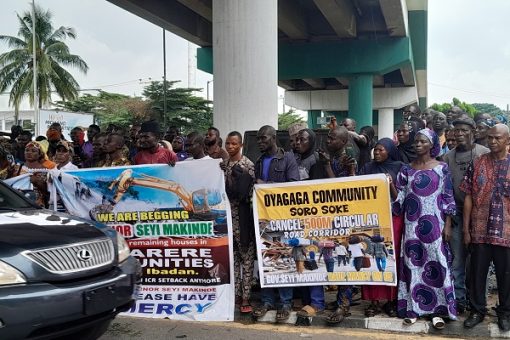
When the Ibadan Circular Road was first announced, it was celebrated as a transformative project—an ambitious 110-kilometre ring designed to ease gridlock, open new economic corridors, and reposition Ibadan as a modern regional hub. But behind the glossy maps, political speeches, and contractor signboards lies another story: the story of the men, women, and families who paid the highest price for the promise of progress.
For these victims, the Circular Road has not been a symbol of development. It has become a monument of melancholy.
“They told us to move, but where do we go?”
At Adebomi, Onigbodogi, Ojeleye, Olowofela, and several other communities along the project’s path, the memory of bulldozers rumbling into once-peaceful neighborhoods still hangs heavily in the air.
“We woke up one morning and saw red marks on our walls,” recalls 67-year-old farmer, Pa Raufu. “Before we understood what was happening, the bulldozers arrived. They told us to move, but where do we go?”
His family home, standing for over four decades, was reduced to rubble in less than an hour.
Stories like his are common. In community after community, residents speak of hurried demolition notices, incomplete enumeration, and compensation packages that did not reflect the true market value of their properties.
Homes Lost, Livelihoods Shattered
For many victims, the first visible loss was their physical property—houses, farmlands, shops, and business sheds. But beneath the surface lies a deeper economic wound.
Farmers lost entire seasons of investment: acres of plantain, cassava, cocoa, maize, and citrus swallowed by the expanding highway corridor. Families who depended on roadside retail—provision shops, food stalls, mechanic workshops, and timber sheds—were left without alternative spaces to trade.
Some recount how they received compensation for buildings but nothing for crops, wells, fences, or long-term economic trees.
“The money they gave me for my house cannot build even a room now,” says Mrs. Olaleye, a widowed trader whose shop and two-room home fell within the right-of-way. “Where do they expect me to start from?”
The road promised prosperity. Instead, many victims now struggle with debt, unemployment, and housing insecurity.
Communities Uprooted, Bonds Broken
Before the Circular Road, many of these neighbourhoods were built around deep communal ties—extended family compounds, shared festivals, farmland cooperatives, and traditional governance structures. The demolition scattered these social networks.
Friends who once shared boundaries now live miles apart. Communal guardianship systems—local vigilantes, shared labour groups, women’s cooperatives—collapsed. Elders who once presided over family lands now feel stripped of authority.
In some cases, ancestral shrines, family cemeteries, and sacred groves were destroyed, leaving behind painful cultural wounds.
“We did not just lose houses,” says Chief Adepoju, a community leader. “We lost our history.”
Emotional Scars: The Melancholy Aftermath
Though rarely acknowledged in official reports, the psychological impact is profound. Many victims recount: Sleepless nights; Constant anxiety; Depression from homelessness; Trauma in children suddenly uprooted from familiar environments; and A lingering sense of injustice;
For numerous families, the Ibadan Circular Road represents not development, but displacement.
The Project’s Broken Promises
Government officials insisted that compensation would be “fair and adequate”, yet interviews with victims reveal inconsistencies:
Some households received payment; others, living a few meters away, received nothing.
Valuations often ignored economic trees, boreholes, fences, and farmlands.
Enumerators sometimes visited when occupants were away.
Compensation was paid years after demolition in some areas, by which time inflation had eroded its value.
These gaps have fueled a sense of abandonment.
The Human Cost of Megaprojects
Infrastructure development is necessary, but the Circular Road highlights a recurring national problem: communities are often expected to bear the cost of progress alone.
Experts argue that proper planning could have softened the following impact:
More transparent and participatory enumeration
Independent valuers
Clear relocation plans
Livelihood restoration programs
Dedicated psychosocial support
Without these, development becomes a burden instead of a blessing.
A Road of Promise, A Trail of Pain
Today, as work continues on various sections of the Ibadan Circular Road, the displaced victims watch with mixed feelings. Some still hope the road will bring prosperity to the region. Others simply want justice—adequate compensation, rehabilitation, and acknowledgement of their struggles.
To them, the Circular Road is more than asphalt and concrete. It is a reminder of dreams interrupted, of homes erased, of memories buried under government machinery.
Until their pains are addressed, the Ibadan Circular Road will remain a road of melancholy.
Mr Abisoye, is the Chairman, Progressive Yes Forum (PYF) of Oyo State APC, writes from Ibadan, Oyo state
