

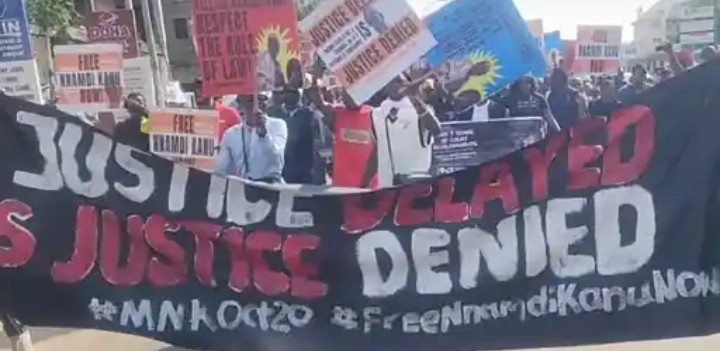

What was intended to be a peaceful demonstration demanding the release of detained IPOB leader, Mazi Nnamdi Kanu, turned chaotic on Monday as security operatives forcefully dispersed protesters led by activist Omoyele Sowore in Abuja.
According to eyewitnesses, the protesters, who had gathered peacefully to demand justice and respect for court rulings ordering Kanu’s release, were met with heavy-handed resistance from police officers. Tear gas canisters were fired indiscriminately into the crowd, while gunshots were reportedly heard as security forces tried to disperse participants. Several journalists covering the protest were also harassed, with some sustaining injuries and damage to their equipment.
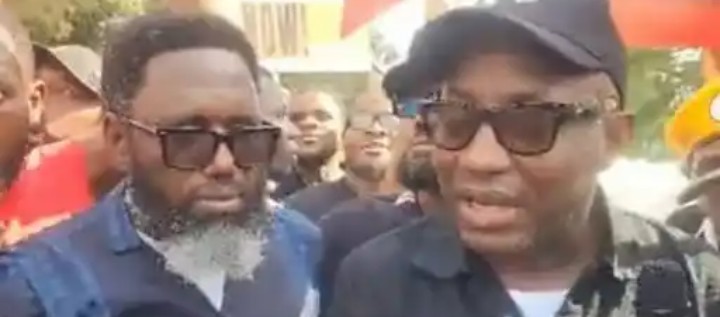
The protest, organized under the banner of civil rights and constitutional freedom, was part of ongoing calls by human rights activists for the federal government to obey court judgments and release Nnamdi Kanu, the detained leader of the Indigenous People of Biafra (IPOB).
Sowore, a former presidential candidate and convener of the #RevolutionNow movement, led the peaceful march, calling for adherence to the rule of law.
“Our protest was peaceful until security operatives attacked us. “This country cannot progress when peaceful assembly is treated as a crime,” Sowore said.
The actions of the police have sparked widespread condemnation from both local and international observers. Amnesty International described the police response as “an assault on democracy and human rights,” calling on authorities to investigate and hold accountable those responsible for the use of excessive force. Similarly, several civil society organizations and legal practitioners have accused the government of suppressing dissent and stifling citizens’ constitutional rights to freedom of assembly and expression.
“The repeated use of force against peaceful protesters is a worrying trend that undermines public trust in security agencies,” said one activist in Abuja.
Nnamdi Kanu has been in detention since 2021, despite a series of court rulings ordering his release. His continued incarceration has been a point of contention between the federal government and human rights groups, who see it as a disregard for judicial authority and due process. The protest, which was meant to draw attention to what activists describe as “judicial impunity,” has now reignited conversations about Nigeria’s shrinking civic space and the government’s growing intolerance of peaceful dissent.
As outrage spreads across social media and civil society circles, many Nigerians are demanding accountability from the police and the government.
“The Nigerian state must understand that peaceful protest is not a crime. Those who gave orders to brutalize citizens should be held responsible,” said a statement from the Coalition for Civil Liberties and Democracy (CCLD).
Human rights observers argue that the frequent use of force against demonstrators reflects a deeper problem, the lack of institutional respect for citizens’ fundamental rights. The attack on journalists, they added, is particularly concerning, as it represents an attempt to silence independent reporting on state misconduct.
The incident once again highlights the fragile relationship between citizens and the state in Nigeria’s democracy. Peaceful protests have often been met with violent suppression, from the #EndSARS demonstrations of 2020 to several regional protests over economic hardship and governance.
As Nigerians continue to demand justice for Nnamdi Kanu and greater respect for human rights, the federal government faces growing pressure to demonstrate that it values dialogue over repression, and law over force.
